
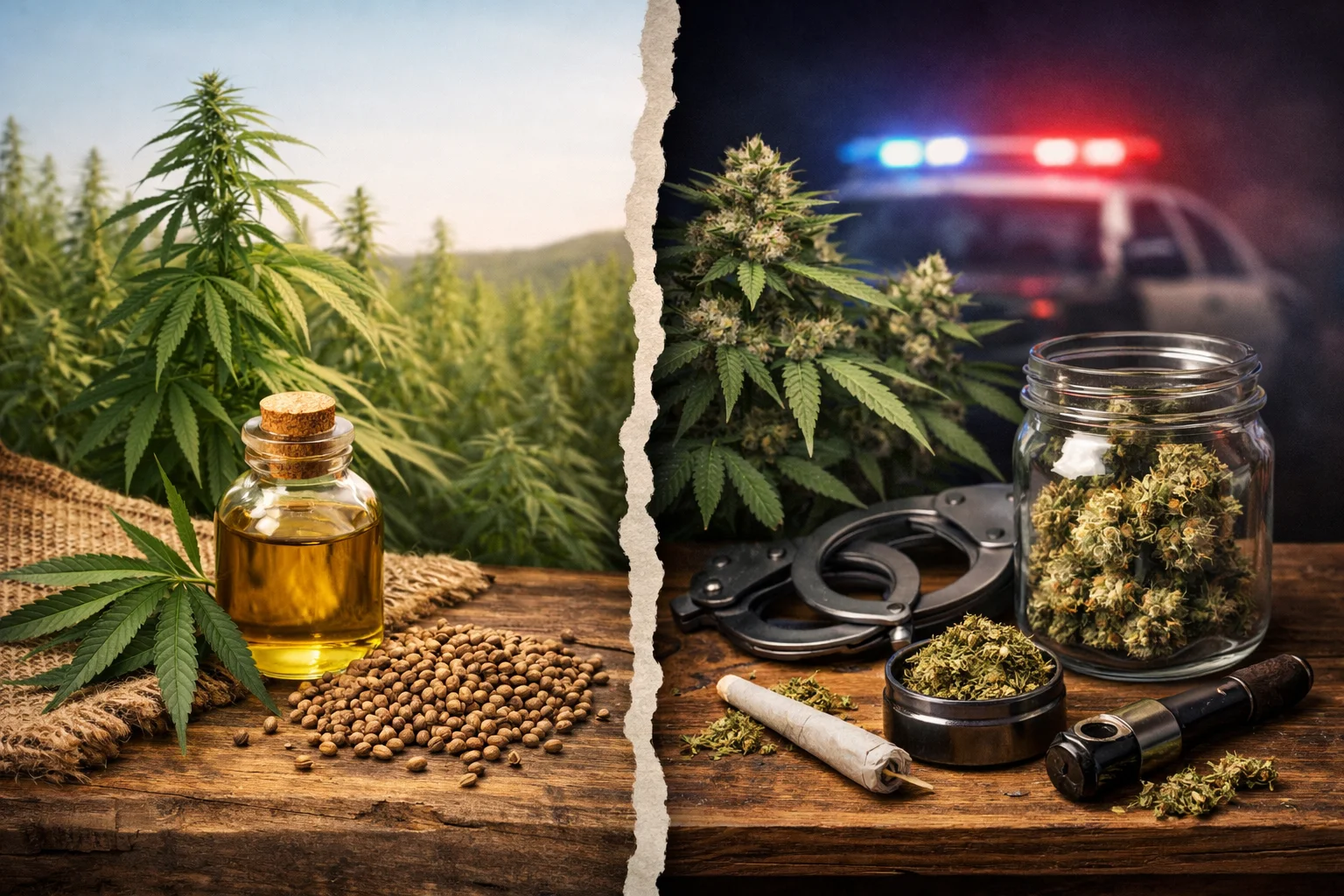
A sign reading “THIS IS NOT MARIJUANA — NO THC” once stood in front of rows of hemp plants in Stanley, Virginia, not as a joke, but as a warning. Farmers were trying to deter thieves by making one thing clear: these plants looked like marijuana, but legally, they were not. That single sign captures the confusion that still surrounds cannabis in the United States today.
Hemp, cannabis, marijuana — the terms are often used interchangeably, yet they’re governed by dramatically different laws. Some forms are legal, others restricted, and new rules are set to tighten definitions even further this fall.
So why does one plant cause so much legal complexity? Let’s find this together in the recently covered news of Jolly Green Life with us!
One Plant, Many Names
Scientifically speaking, hemp and marijuana are the same species: Cannabis sativa. According to Kelly Vining, an associate professor at Oregon State University who specializes in hemp genomics, botanists generally consider hemp and marijuana to be subspecies rather than entirely different plants.
Nick Johnson, author of Grass Roots, explains that cannabis is one of the world’s oldest domesticated crops — and also one of the most biologically mysterious. The plant produces more than 480 chemical constituents, yet U.S. regulators focus almost exclusively on a single compound: THC, the cannabinoid responsible for psychoactive effects.
That narrow focus is what drives the legal divide.
How Federal Law Separates Hemp From Marijuana
Under federal law, the distinction between hemp and marijuana comes down to THC concentration. If a cannabis plant contains less than 0.3% THC, it qualifies as legal hemp. Anything above that threshold is classified as marijuana.
Marijuana itself is currently in the process of being reclassified from a Schedule I drug to Schedule III, while hemp is not considered a controlled substance at all. Despite this, both originate from the same species and share most of their genetic makeup.
Later this year, however, those definitions are set to change again.
The 2018 Farm Bill Loophole and What’s Changing
The 2018 Farm Bill unintentionally opened the door to a booming hemp-derived THC market. Because the law focused on THC levels in the plant, companies began producing intoxicating beverages and products by manipulating hemp-derived cannabinoids.
Colorful THC drinks — now sold in liquor stores and convenience shops — exist largely because of this loophole.
Congress is now moving to close it.
A new federal law scheduled to take effect in November will regulate THC content in final products, not just the plant itself. Under the updated rules, any product containing more than 0.4 milligrams of THC or similar intoxicating cannabinoids will no longer qualify as hemp and will become illegal.
Industry critics warn the changes could devastate THC beverage companies and even restrict products containing non-intoxicating cannabinoids like CBD if they include trace THC.
For broader cannabis policy context and industry updates, platforms like jolly green life frequently track how these evolving rules affect consumers and businesses alike.
Hemp’s Deep Roots in American History
Long before cannabis was controversial, hemp was essential.
In colonial America, hemp was used to make ropes, sails, clothing, and agricultural twine. According to historical records, hemp was cultivated in New England as early as 1629, and colonies such as Virginia rewarded farmers who grew it while penalizing those who didn’t.
Importantly, early American hemp was not used for intoxication. As Johnson emphasizes, people in George Washington’s era weren’t smoking or ingesting hemp — they grew it strictly for industrial purposes.
Where Psychoactive Cannabis Came From
Cannabis used for its mind-altering effects developed far from North America. Johnson traces its origins to the Hindu Kush mountains of Afghanistan, where shorter, resin-heavy plants evolved to protect themselves from intense sunlight. That resin is rich in THC.
The British encountered psychoactive cannabis in India, and its spread accelerated after slavery was abolished in the Caribbean in 1834. Indentured laborers from India brought cannabis traditions with them, influencing cultural practices such as Rastafarianism.
By 1851, cannabis extracts were listed in the Pharmacopoeia of the United States, recognized as legitimate medicine for pain and other conditions.
How Language and Politics Fueled Criminalization
The first documented U.S. cannabis ban occurred in El Paso, Texas, in 1915, despite medical objections. Federal regulation followed with the Marihuana Tax Act of 1937, deliberately shifting language from “cannabis” to “marijuana” — a move historians widely associate with racialized fear campaigns targeting Mexican and Black communities.
Restrictions tightened further in the early 1970s when President Richard Nixon placed marijuana into Schedule I, despite his own drug commission recommending decriminalization. Later admissions from Nixon aides revealed the policy was used to target anti-war protesters and Black neighborhoods.
Unlike other Schedule I substances, the DEA itself acknowledges that no deaths from marijuana overdose have ever been reported.
The Future of Hemp and Cannabis Regulation
Public opinion on cannabis has shifted dramatically since the 1970s. Many states now allow recreational or medical use, and cannabinoids like CBD have gained recognition for therapeutic benefits. Still, federal restrictions continue to limit scientific research.
Advocacy groups argue that separating hemp and marijuana politically makes reform easier — even if, biologically, the distinction makes little sense.
As Adam Smith of the Marijuana Policy Project notes, lawmakers often support hemp reforms while distancing themselves from marijuana, despite both relying on the same cannabinoid pathways.
Beyond THC: Hemp’s Untapped Potential
Kelly Vining points out that relaxed hemp laws have already enabled broader research into the plant’s uses. Hemp seeds are highly nutritious, and hemp fibers are now being used in construction materials like hempcrete.
While THC dominates the legal conversation, the plant’s industrial and nutritional potential continues to expand — assuming regulation doesn’t tighten too far.
For authoritative federal cannabis policy references, readers can explore research and regulatory updates via institutions like the U.S. Department of Agriculture (USDA), which oversees hemp cultivation standards nationwide.
FAQs
Are hemp and marijuana the same plant?
Yes. Botanically, both hemp and marijuana belong to the species Cannabis sativa. The legal distinction is based on THC levels, not biology.
Why is THC so important in cannabis laws?
U.S. regulations focus on THC because it causes psychoactive effects. Hemp must stay below federally defined THC limits to remain legal.
What changes are coming to hemp laws in November?
New federal rules will limit THC in finished products. Any product with more than 0.4 mg of THC will no longer qualify as legal hemp.
Did early Americans use hemp as a drug?
No. Hemp was grown for fiber and industrial uses. Psychoactive cannabis varieties were introduced later from other parts of the world.
Could CBD products be affected by new hemp rules?
Yes. Some CBD products may become illegal if they contain trace amounts of THC above the new thresholds.

James Carter has a background in science communication and a knack for breaking down complex topics into easy-to-understand stories. He loves diving deep into the facts behind CBD’s rise—from policy updates and market trends to new research. James is passionate about sharing the latest news and helping others understand what it all means. He writes clear and honest articles to keep readers updated on CBD laws, health benefits, and new products. When he’s not writing, he enjoys spending time outdoors and exploring natural ways to stay healthy.