
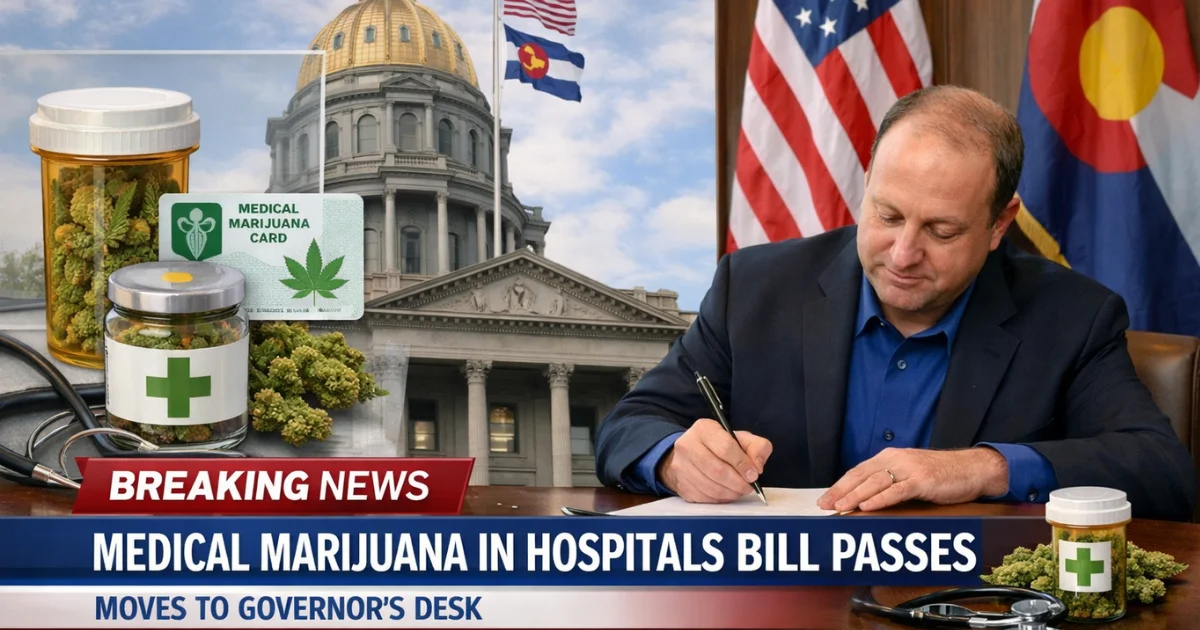
Terminally ill patients in Colorado may soon gain the right to use medical marijuana inside hospitals and healthcare facilities after lawmakers approved a new bill that now heads to the governor’s desk.
The Colorado House of Representatives passed the legislation in a 49–12 vote on Tuesday, sending the measure to Jared Polis, the state’s governor and a longtime supporter of cannabis reform.
The proposal—introduced by Kyle Mullica, a Democratic state senator—would allow patients with terminal illnesses to access medical cannabis while receiving treatment in licensed healthcare facilities such as hospitals. However, amendments added during the legislative process have sparked criticism from patient advocates who argue the revised language weakens the bill’s original intent.
Lawmakers Say Patients Deserve More Treatment Options
Supporters of the legislation say it represents an important step toward compassionate care for patients facing severe medical conditions.
During debate on the House floor, Representative Ryan Gonzalez voiced support for the proposal, emphasizing that patients should have access to alternative treatment options.
“This is a good bill,” Gonzalez said while speaking to lawmakers. “Patients who are terminally ill—and others dealing with serious conditions—should have the option to explore alternative methods of treatment, and that includes cannabis.”
He added that residents in his district strongly supported the proposal when he discussed it with them back home.
“I went back to my district and people were really excited about this,” Gonzalez said. “For many patients, this could offer a meaningful option.”
Advocates Say Amendments Weaken the Reform
While the bill has received bipartisan support, not everyone is satisfied with the version lawmakers ultimately approved.
Advocates say the legislation was originally designed to ensure that healthcare facilities must allow medical cannabis use for qualifying patients. However, amendments changed the language so hospitals would only have the option to allow it.
Critics argue that this change could create a patchwork system where some hospitals permit medical marijuana while others prohibit it.
One of the most vocal supporters of stronger language has been Jim Bartell, a parent whose late son inspired legislation known as Ryan’s Law in California and other states.
Speaking before a House committee earlier this month, Bartell urged lawmakers to restore the bill’s original wording.
“For families like mine, this legislation isn’t theoretical,” Bartell said. “It’s about ethical and compassionate care.”
He argued that lawmakers should keep the original terms such as “shall” and “must” to ensure hospitals consistently allow patients access to medical cannabis.
Sponsors Respond to Concerns
Representative Lieder, one of the bill’s sponsors, said during committee discussions that she had only recently learned about some of the amendments that patient advocates oppose.
The issue was raised again during a second reading of the bill on the House floor, but lawmakers ultimately decided not to revise the language before passing the measure.
As a result, the version approved by the legislature keeps the optional framework for hospitals rather than requiring compliance statewide.
What the Bill Would Do
If signed into law, SB 26-007 would allow healthcare facilities to establish internal policies governing the use of medical marijuana by patients.
Hospitals and healthcare providers would be able to develop guidelines covering:
• How medical cannabis can be used inside the facility
• Storage requirements
• Administration procedures for patients
Importantly, the legislation also limits the authority of the Colorado Department of Public Health and Environment (CDPHE).
Under the bill, the department could not require hospitals to adopt medical marijuana policies as a condition for obtaining or renewing licenses or certifications.
Additionally, healthcare facilities would be allowed to suspend the policy if federal agencies threaten enforcement action.
Implementation and Costs
According to a fiscal analysis of the legislation, the bill is expected to create only a small increase in workload for regulators.
Beginning in fiscal year 2026–2027, the Health Facilities and Emergency Medical Services Division within CDPHE would provide outreach and educational guidance to licensed healthcare providers about medical cannabis use.
Officials noted that any additional work—such as legal services related to rulemaking or implementation—could likely be handled within the department’s existing budget.
Legal Protections for Hospitals
Additional amendments adopted in the Senate clarify that hospitals would not be required to store or distribute medical marijuana themselves.
Instead, patients or caregivers would remain responsible for providing cannabis products.
The bill also includes provisions designed to limit legal liability for healthcare institutions that choose to allow medical marijuana use.
Colorado’s Cannabis Industry Continues Growing
The debate over hospital cannabis access comes as Colorado’s legal marijuana industry continues to generate major revenue.
In December, Governor Polis highlighted that the state had surpassed $1 billion in annual marijuana sales, demonstrating the ongoing strength of the regulated cannabis market.
Polis has also recently voiced opposition to another cannabis-related policy issue. Last month he said Colorado should not have joined a lawsuit supporting a federal ban on gun ownership for people who use marijuana—a case that recently reached the U.S. Supreme Court.
The governor stated that he personally disagrees with the legal position taken by the state attorney general in that case.
What Happens Next
With the legislation now passed by both chambers of the state legislature, the bill awaits the governor’s decision.
If Polis signs the measure into law, Colorado would join several other states that allow terminally ill patients to use medical cannabis in healthcare facilities under policies modeled after Ryan’s Law.
For patients and families facing serious illness, the measure could open the door to additional options for symptom relief while receiving hospital care.
Final Thoughts
As cannabis policy continues evolving across the United States, lawmakers are increasingly focusing on how medical marijuana can fit into traditional healthcare systems.
Colorado’s proposed hospital cannabis policy reflects that shift—though the debate over whether hospitals should allow or be required to allow medical cannabis remains unresolved.
For patients seeking compassionate treatment options, the governor’s upcoming decision could mark another important step in the broader evolution of cannabis healthcare policy.
If you want to stay updated on marijuana legislation, cannabis research, and legalization developments, follow more coverage and policy insights at Jolly Green Life.
FAQs
1. What does the new Colorado medical marijuana hospital bill do?
The legislation would allow terminally ill patients to use medical marijuana inside healthcare facilities such as hospitals if those facilities choose to permit it.
2. Has the Colorado cannabis hospital bill passed?
Yes. The Colorado House approved the bill with a 49–12 vote, and it now heads to the governor for final approval.
3. Will hospitals be required to allow medical marijuana?
No. Amendments changed the bill so hospitals may choose whether to allow medical cannabis rather than being required to permit it.
4. What is Ryan’s Law related to medical cannabis?
Ryan’s Law is legislation in several states allowing terminally ill patients to use medical marijuana in healthcare facilities.
5. What happens if the governor signs the bill?
If signed into law, healthcare facilities in Colorado could create policies allowing patients to use medical marijuana during treatment.

James Carter has a background in science communication and a knack for breaking down complex topics into easy-to-understand stories. He loves diving deep into the facts behind CBD’s rise—from policy updates and market trends to new research. James is passionate about sharing the latest news and helping others understand what it all means. He writes clear and honest articles to keep readers updated on CBD laws, health benefits, and new products. When he’s not writing, he enjoys spending time outdoors and exploring natural ways to stay healthy.