
The U.S. cannabis and hemp industries are entering one of the most critical phases in their history. As 2026 unfolds, federal rescheduling talks, looming hemp crackdowns, and growing pressure from lawmakers are reshaping how cannabis and hemp businesses operate across the country. For consumers, entrepreneurs, and advocates, these developments signal both opportunity and uncertainty. Here is our complete insight into U.S. cannabis and hemp news.
Federal Cannabis Rescheduling Moves Forward
One of the biggest headlines in cannabis news is the federal government’s push to reschedule marijuana. According to a recent report by Reuters on federal cannabis rescheduling, the U.S. government is actively moving toward reclassifying marijuana from Schedule I to Schedule III, a shift that could significantly reduce tax and research barriers for licensed cannabis businesses.
For cannabis businesses, rescheduling could be transformative. Schedule III status would ease the burden of IRS Section 280E, which currently prevents cannabis companies from deducting standard business expenses. This change alone could improve profitability and stability across legal cannabis markets in the U.S.
However, rescheduling does not equal legalization. Cannabis would remain federally illegal under the Controlled Substances Act, and states would still control their own regulatory frameworks. While this move is widely seen as progress, it stops short of comprehensive reform.
Hemp-Derived THC Products Face Major Crackdown
While cannabis rescheduling offers optimism, the hemp sector is facing mounting pressure. A provision included in a recent federal spending bill is set to dramatically redefine what qualifies as legal hemp. If enforced as written, the rule would effectively ban most intoxicating hemp-derived products by November 2026.
Industry experts warn that the proposed changes could eliminate most hemp products, a concern echoed in recent coverage by Cannabis Business Times on hemp-derived THC regulations. This includes popular items such as delta-8 THC gummies, delta-9 hemp beverages, THC vapes, and even products containing THCA. The new definition limits total THC content per container and excludes cannabinoids that are chemically altered or synthesized, even if derived from hemp.
The growing popularity of delta-8 THC beverages and edibles has drawn national attention, with Food Dive reporting on how lawmakers aim to close what many call the hemp loophole. Industry analysts estimate that as much as 90–95% of current hemp-derived THC products could disappear from shelves, threatening the businesses that depend on them.
Lawmakers Push Back Against Hemp Restrictions
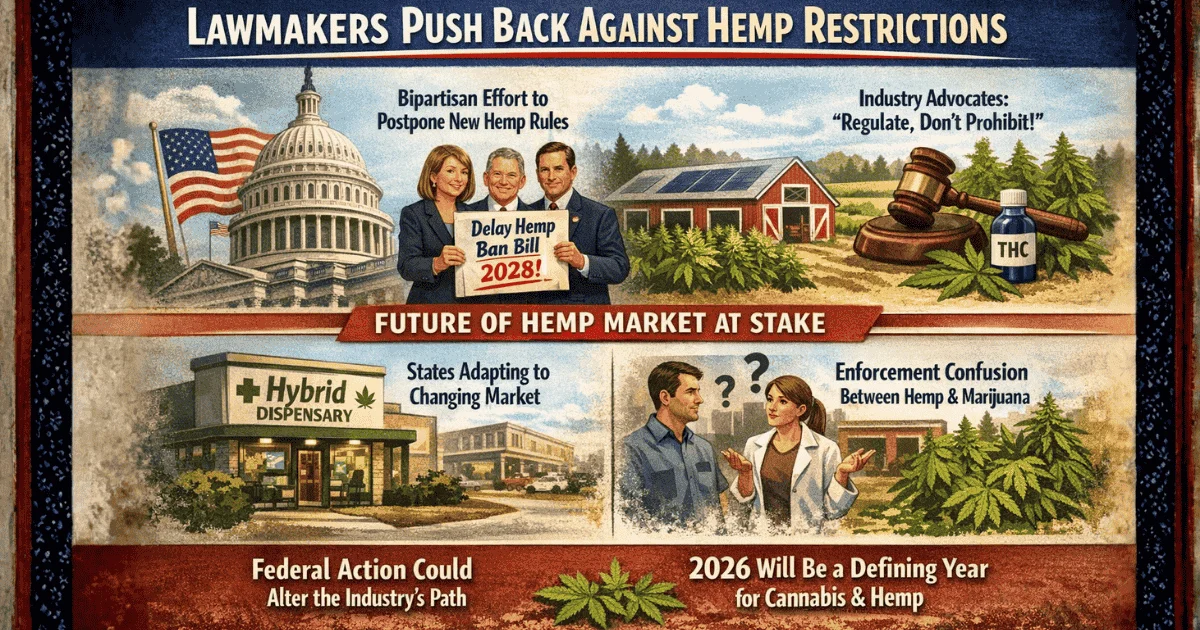
The proposed hemp crackdown has not gone unchallenged. A bipartisan group of lawmakers has introduced legislation aimed at delaying enforcement of the new hemp rules until at least 2028. In response to industry backlash, several lawmakers have introduced legislation to delay enforcement, according to updates published by Marijuana Moment on bipartisan hemp reform efforts.
Advocates for reform emphasize the need for clear, science-based regulation rather than sudden bans. Many believe the hemp industry needs time to adapt, test products properly, and align with consumer safety standards instead of facing an abrupt shutdown. Whether Congress steps in to delay or repeal the hemp restrictions will likely determine the future of the U.S. hemp-derived THC market.
States Adapt as Market Pressures Grow
At the state level, cannabis operators are adjusting strategies to survive tightening margins and shifting consumer behavior. Some dispensaries are expanding into hybrid models that serve both recreational customers and medical patients under one roof.
Medical cannabis enrollment has declined in several states since adult-use legalization, prompting businesses to rethink how they serve patients. Hybrid models allow operators to remain competitive while offering broader access and more tailored product options.
Meanwhile, states continue to wrestle with the gray area between hemp and marijuana. Inconsistent enforcement and conflicting rules have created confusion for retailers and consumers alike. Policy analysts argue that an outright ban could disrupt small businesses nationwide, a concern highlighted in recent hemp policy analysis published by Reason Magazine.
What This Means for the Future
The U.S. cannabis and hemp industries are clearly at an inflection point. Federal cannabis rescheduling could legitimize the industry in ways previously unimaginable, opening doors to research, investment, and financial services. At the same time, stricter hemp regulations threaten to dismantle a fast-growing sector unless lawmakers intervene.
For consumers, these changes may mean fewer hemp-derived THC products but potentially safer and more regulated options in the long run. For businesses, adaptability will be key as the legal landscape continues to evolve.
One thing is certain: 2026 will be a defining year for cannabis and hemp in America—and the decisions made now will shape the industry for years to come. For more authentic and recent updates about U.S. cannabis and hemp news, stay tuned to Jolly Green Life.
FAQs
What is federal cannabis rescheduling in 2026?
It’s the U.S. government’s plan to move marijuana from Schedule I to Schedule III, allowing easier research and reducing tax burdens for legal cannabis businesses.
Will hemp-derived THC products be banned?
Most intoxicating hemp-derived THC products, like delta-8 and delta-9 items, could be banned federally by November 2026 unless Congress delays enforcement.
How does rescheduling affect cannabis businesses?
Rescheduling could ease tax restrictions, allow standard business deductions, and improve access to banking and investment for licensed cannabis companies.
How are states responding to federal hemp and cannabis rules?
Many states are adopting hybrid models, serving both recreational and medical customers, and navigating conflicting federal and state regulations.

James Carter has a background in science communication and a knack for breaking down complex topics into easy-to-understand stories. He loves diving deep into the facts behind CBD’s rise—from policy updates and market trends to new research. James is passionate about sharing the latest news and helping others understand what it all means. He writes clear and honest articles to keep readers updated on CBD laws, health benefits, and new products. When he’s not writing, he enjoys spending time outdoors and exploring natural ways to stay healthy.