
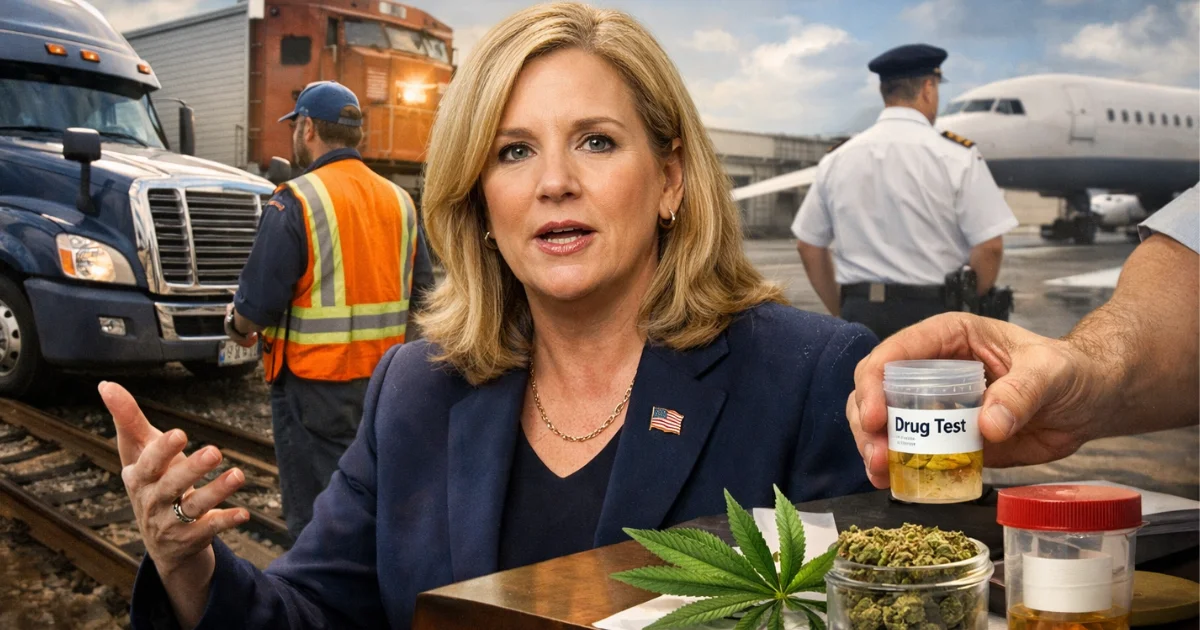
A Democratic lawmaker is urging federal regulators to reconsider how marijuana drug testing is handled for transportation workers, arguing that current policies are outdated, overly strict, and actively harming workforce availability, even when employees are not impaired on the job.
During a recent hearing before the House Transportation and Infrastructure Committee, Rep. Randall Washington’s colleague Rep. Emily Randall (D-WA) raised concerns that federal drug testing standards punish workers for legal, off-duty cannabis use that has no real connection to job performance or public safety.
Her remarks come as the federal government continues to debate the THC schedule of marijuana and whether cannabis should remain treated the same as far more dangerous substances under federal law.
Outdated Rules Are Shrinking the Transportation Workforce
Rep. Randall, who serves as a co-chair of the Congressional Ferry Caucus, explained that Washington State’s ferry system is facing serious staffing shortages, and federal marijuana testing rules are part of the problem.
Under current regulations, ferry operators and other safety-sensitive transportation workers can test positive for THC weeks after legal marijuana use, even when they are no longer impaired. This has forced otherwise qualified workers out of service.
Randall suggested that federal agencies should explore “creative solutions”, including adjusting testing windows or reconsidering how marijuana use is evaluated in states where recreational cannabis is legal.
Right now, someone who uses marijuana legally on their personal time in Washington could still fail a test nearly a month later and lose their job. That reality, she said, makes it harder to build and retain a reliable workforce.
Calls To Relax Rules, Not Eliminate Safety Standards
Importantly, Randall did not argue for removing safety protections. Instead, she emphasized that any policy change should ensure marijuana is not used on the job and not consumed within a reasonable window before a shift begins.
Her comments reflect a broader national conversation about whether existing drug tests measure impairment or simply detect past use, an issue also tied to the rise of the at home marijuana test market and growing skepticism around traditional screening methods.
Marijuana Reform Legislation And Federal Rescheduling
Randall is also a cosponsor of federal marijuana legalization legislation, including the Marijuana Opportunity, Reinvestment and Expungement (MORE) Act. The bill previously passed the House twice but has stalled in the current Congress.
Meanwhile, the Trump administration is actively reviewing a proposal to move marijuana from Schedule I to Schedule III under the Controlled Substances Act, a shift in THC schedule classification that would acknowledge medical use but stop short of full legalization.
Despite that ongoing review, federal agencies are making it clear that nothing has changed yet.
DOT Confirms No Immediate Changes To Drug Testing
According to the U.S. Department of Transportation, federal transportation drug testing rules require employees in safety-sensitive positions to comply with strict marijuana testing standards, even as federal agencies review potential changes to marijuana’s THC schedule. Last month, the U.S. Department of Transportation issued a bulletin reminding employers and workers that all existing marijuana testing rules remain fully in place.
Until Attorney General Pam Bondi completes the rescheduling process, marijuana remains a Schedule I substance. As a result, DOT says it is still unacceptable for any safety-sensitive transportation employee to use marijuana.
That guidance applies regardless of whether cannabis use is medical or recreational, and regardless of state laws that allow it.
DOT further clarified that laboratories, medical review officers, and substance misuse professionals must continue operating under current standards. In short, no rule changes are happening yet, even as cannabis policy evolves elsewhere.
Why Rescheduling Alone May Not Change Anything
Former Transportation Secretary Pete Buttigieg previously explained why marijuana rescheduling may not impact DOT drug testing at all.
In 2024 testimony, Buttigieg said DOT regulations list marijuana by name, not by drug category. That means even if cannabis moves to a different THC schedule, testing requirements could remain unchanged.
He made those remarks while responding to Rep. Rick Harrelson—often referred to as Rick Harrelson in trucking policy discussions—who raised concerns echoed by the American Trucking Associations about road safety risks tied to marijuana reform.
The authority for DOT’s position comes from the 1991 Omnibus Transportation Employee Testing Act, sometimes called the omnibus test. That law allows the transportation secretary to require testing for any substance deemed a safety risk.
Because of this, the omnibus test framework gives DOT broad discretion, regardless of federal rescheduling.
THC, Impairment, And The Science Gap
Another major issue driving this debate is the lack of scientific consensus linking THC levels to real-world impairment.
A 2024 scientific review found no consistent linear relationship between blood THC levels and driving performance in most studies. In many cases, drivers with detectable THC showed no meaningful impairment at all.
Similarly, the National Highway Traffic Safety Administration reported that there is little evidence supporting fixed THC limits used in some states. Unlike alcohol, THC concentration in blood does not reliably predict crash risk.
A Department of Justice researcher echoed this concern, explaining that frequent users and occasional users can have wildly different THC levels with very different effects. This makes reliance on chemical thresholds deeply flawed.
Why Policy Reform Is Gaining Momentum
As marijuana legalization expands nationwide, contradictions between federal rules and state laws are becoming harder to ignore. Issues like Missouri recreational limits out-of-state purchases, employment testing conflicts, and inconsistent enforcement highlight the growing policy gap.
In this environment, calls to “weed away” outdated regulations are growing louder. Advocates argue it’s time to weed away rules that punish lawful behavior without improving safety. Others warn that failing to modernize testing will continue to push workers out of essential industries.
Some critics have even mocked the current approach as turning DOT into a “weed chair” of outdated science rather than a regulator grounded in evidence.
What Comes Next
For now, DOT insists public safety remains its top priority and says it will continue monitoring the rescheduling process. Any future updates, officials say, will be communicated clearly to the transportation industry.
But pressure from lawmakers like Randall Washington’s delegation, combined with mounting scientific evidence, suggests the conversation is far from over.
As cannabis reform advances, federal agencies may soon be forced to decide whether to continue relying on blunt testing tools or finally adopt policies that reflect real impairment rather than past, legal use.
Until then, transportation workers remain caught between evolving state laws and rigid federal standards that many believe are long overdue to be weeded away. For most recent and aunthentic cannabis news, stay tuned to Jolly Green Life.
FAQs
1. Why are lawmakers calling for changes to marijuana drug testing rules?
Lawmakers argue that current federal drug testing policies punish transportation workers for legal, off-duty marijuana use that does not cause impairment, making it harder to maintain a stable workforce.
2. Do federal marijuana drug testing rules still apply if cannabis is legal in a state?
Yes. Transportation workers in safety-sensitive positions must still comply with federal marijuana testing rules, even in states where recreational or medical marijuana is legal.
3. Will changing marijuana’s THC schedule affect DOT drug testing?
Not necessarily. Even if marijuana is moved to a different THC schedule, the Department of Transportation can continue testing for marijuana under the Omnibus Transportation Employee Testing Act.
4. Why is THC testing considered unreliable for impairment?
Studies show there is no consistent link between THC levels in blood and actual impairment, especially among frequent users, making current testing methods poor indicators of real-time safety risk.
5. Are at-home marijuana tests accepted for transportation workers?
No. At home marijuana tests are not accepted for DOT-regulated employees, who must follow federally approved testing procedures and laboratory standards.

James Carter has a background in science communication and a knack for breaking down complex topics into easy-to-understand stories. He loves diving deep into the facts behind CBD’s rise—from policy updates and market trends to new research. James is passionate about sharing the latest news and helping others understand what it all means. He writes clear and honest articles to keep readers updated on CBD laws, health benefits, and new products. When he’s not writing, he enjoys spending time outdoors and exploring natural ways to stay healthy.