
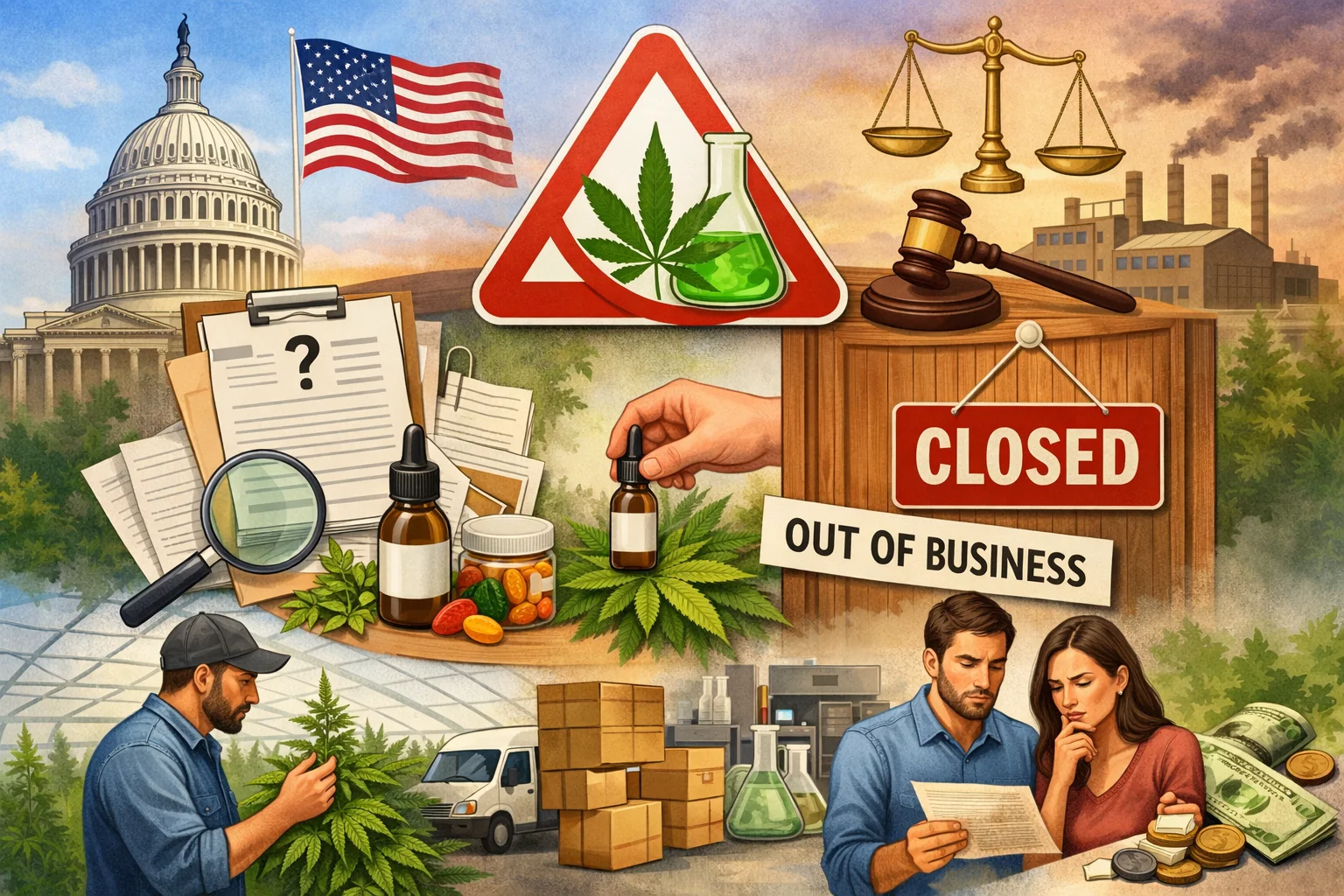
Federal hemp laws are on the verge of a massive transformation that could upend the entire industry. As of early 2026, the market is bracing for a significant shift following a new bill signed by President Donald Trump—originally introduced as a provision by Senator Mitch McConnell—that effectively sets a federal ban on hemp products as we know them.
While the 2018 Farm Bill previously legalized hemp by focusing on a 0.3% delta-9 THC limit, this new legislation moves the goalposts to a “total THC” standard. This change is designed to close the so-called “hemp loophole,” but industry experts warn it may lead to recriminalizing hemp-derived products that millions of Americans currently use legally.
What’s Happening with the Federal THC Ban?
As part of an appropriations bill President Donald Trump signed late last year, the federal government is moving to roll back many of the hemp freedoms that were established under the 2018 Farm Bill — the landmark legislation that first legalized hemp during Trump’s first term. Under this new spending measure, many hemp-derived THC products will once again be prohibited starting in November 2026.
This has triggered urgent questions across the hemp industry: Is THC getting banned? Will THC gummies be banned? Did Trump sign a THC ban? The short answer is — the legislation has been signed, and unless Congress intervenes, a sweeping hemp ban 2025/2026 goes into effect later this year.
The FDA’s Critical Deadline on Hemp THC and Cannabinoids
Within the hemp legislation, the FDA was handed a 90-day mandate following the bill’s signing to publish three key lists:
- All cannabinoids the FDA knows to be naturally produced by cannabis
- All tetrahydrocannabinol (THC) class cannabinoids naturally occurring in the plant
- All other cannabinoids with similar effects to THC — or marketed as having similar effects
Beyond that, the agency was also directed to clarify the definition of a “container” as it relates to hemp-derived product THC serving sizes. Under the law, a container is defined as the innermost packaging in direct contact with the final hemp-derived cannabinoid product — whether that’s a jar, bottle, bag, box, carton, can, packet, or cartridge.
The FDA’s deadline for publishing all of this guidance fell on a Tuesday in February 2026. Whether the agency meets it remains to be seen. Federal agencies have a long track record of missing congressionally mandated deadlines, especially when it comes to cannabis and hemp policy.
The FDA Deadline and the “Container” Controversy
Under the law Trump signed, the FDA was given a strict 90-day deadline to publish specific lists to help the thc government oversight transition. These lists include:
-
All known naturally occurring cannabinoids.
-
All tetrahydrocannabinol-class cannabinoids.
-
Any other components that have (or are marketed to have) similar effects to THC.
A major point of contention is how the agency defines a thc container. The current law defines it as the “innermost wrapping” in direct contact with the product. This is critical because the new FDA limit THC per serving hemp products is set at a microscopic 0.4 mg of total THC per container.
For context, most delta 9 effects are typically felt at 5mg to 10mg per serving. A 0.4 mg cap per package would essentially make almost every full-spectrum CBD oil and THC gummy currently on the market illegal.
Will THC Gummies Be Banned?
If the hemp ban 2026 goes into effect as written this November, the answer is likely yes. The thc product ban covers:
-
Delta-8 and other synthetic isomers.
-
Any product exceeding the 0.4 mg total THC limit.
-
THC drinks and edibles that were previously federally legal THC options.
Industry leaders like Jim Higdon of Cornbread Hemp and Adam Terry of Cantrip have expressed concerns that this blanket ban will create “chaos and confusion.” Even if you are in a state where marijuana is legal, this federal ban on THC products could disrupt interstate commerce and manufacturing.
Is There a Legal Alternative to Weed?
As the thc bill looms, lawmakers like Rep. Morgan Griffith and Marc Veasey have introduced the HEMP Act as a potential legal alternative. Instead of an outright marajuana ban or hemp prohibition, this act would create a regulated pathway for adult-use hemp products (21+), requiring tamper-proof packaging, QR codes for lab results, and clear labeling.
Meanwhile, some are looking to the Hemp Planting Predictability Act, which seeks to delay the ban for two years to allow for a better regulatory compromise.
The Trump Connection: Did Trump Recriminalize Hemp?
The political landscape is complex. While Donald Trump signs THC ban language within the larger spending bill, he also recently issued an executive order to reschedule marijuana to Schedule III. This has led to a strange “push-pull” dynamic:
-
The spending bill creates a federal ban on hemp.
-
The Executive Order seeks to protect full-spectrum CBD and expand medical research.
The ramifications of these conflicting policies are still unfolding. Whether the marijuana ban 2026 stick depends heavily on whether Congress passes a “fix” before the November 12th deadline.
Industry and Political Backlash Against the THC Ban
Opposition to the federal THC product ban is coming from multiple directions:
- Hemp businesses and trade groups have been vocal about the devastating ramifications of the ban on farmers and entrepreneurs across the country.
- The Democratic Governor of Kentucky has called the hemp industry an important part of the state economy that deserves state-level regulation rather than federal prohibition.
- A leading veterans organization has warned Congress that the blanket ban on consumable hemp products could inadvertently shut down critical research into hemp-derived therapies.
- Four out of five marijuana consumers surveyed said they oppose the recriminalization of hemp THC products — though that poll was conducted before Trump’s cannabis rescheduling executive order.
What Happens Next? Key Dates and Milestones
- FDA publication deadline (February 2026): The agency must publish its cannabinoid lists and container definition guidance.
- November 2026: The hemp ban 2026 effective date, when the federal THC ban is currently set to take effect.
- Congressional action: Multiple bills — the HEMP Act, the Hemp Planting Predictability Act, and others — are in play. Whether any pass before November will determine the future of the hemp marketplace.
The question on everyone’s minds — when does the hemp ban go into effect? — still has a clear legal answer: November 2026. But the political landscape is shifting rapidly, and the outcome is far from certain.
Stay Informed with Jolly Green Life
Navigating CBD laws and new hemp laws is getting harder by the day. At Jolly Green Life, we are committed to tracking every update on the US hemp ban and providing you with the most accurate hemp industry news updates.
FAQs
1. Is the federal THC ban currently in effect?
No, while President Trump signed the legislation, the strict new limits and re-classification of hemp are not scheduled to take officially effect until November 2026.
2. Will CBD gummies be banned under the new law?
Most full-spectrum CBD gummies will become illegal because they exceed the new 0.4 mg total THC limit per container, regardless of their dry weight percentage.
3. Did Trump recriminalize hemp-derived products?
By signing the 2025 appropriations bill containing Mitch McConnell’s hemp provision, the federal government has effectively moved to ban most consumable hemp cannabinoids.
4. What is the new FDA limit for THC per serving?
The law shifts focus from “per serving” to a “per container” limit, capping the total amount of all tetrahydrocannabinols at a restrictive 0.4 mg per package.
5. Are delta-9 gummies legal in Texas and Florida right now?
Currently, they remain legal under the 2018 Farm Bill standards, but the upcoming federal ban will override state protections unless new legislation like the HEMP Act passes.

James Carter has a background in science communication and a knack for breaking down complex topics into easy-to-understand stories. He loves diving deep into the facts behind CBD’s rise—from policy updates and market trends to new research. James is passionate about sharing the latest news and helping others understand what it all means. He writes clear and honest articles to keep readers updated on CBD laws, health benefits, and new products. When he’s not writing, he enjoys spending time outdoors and exploring natural ways to stay healthy.