
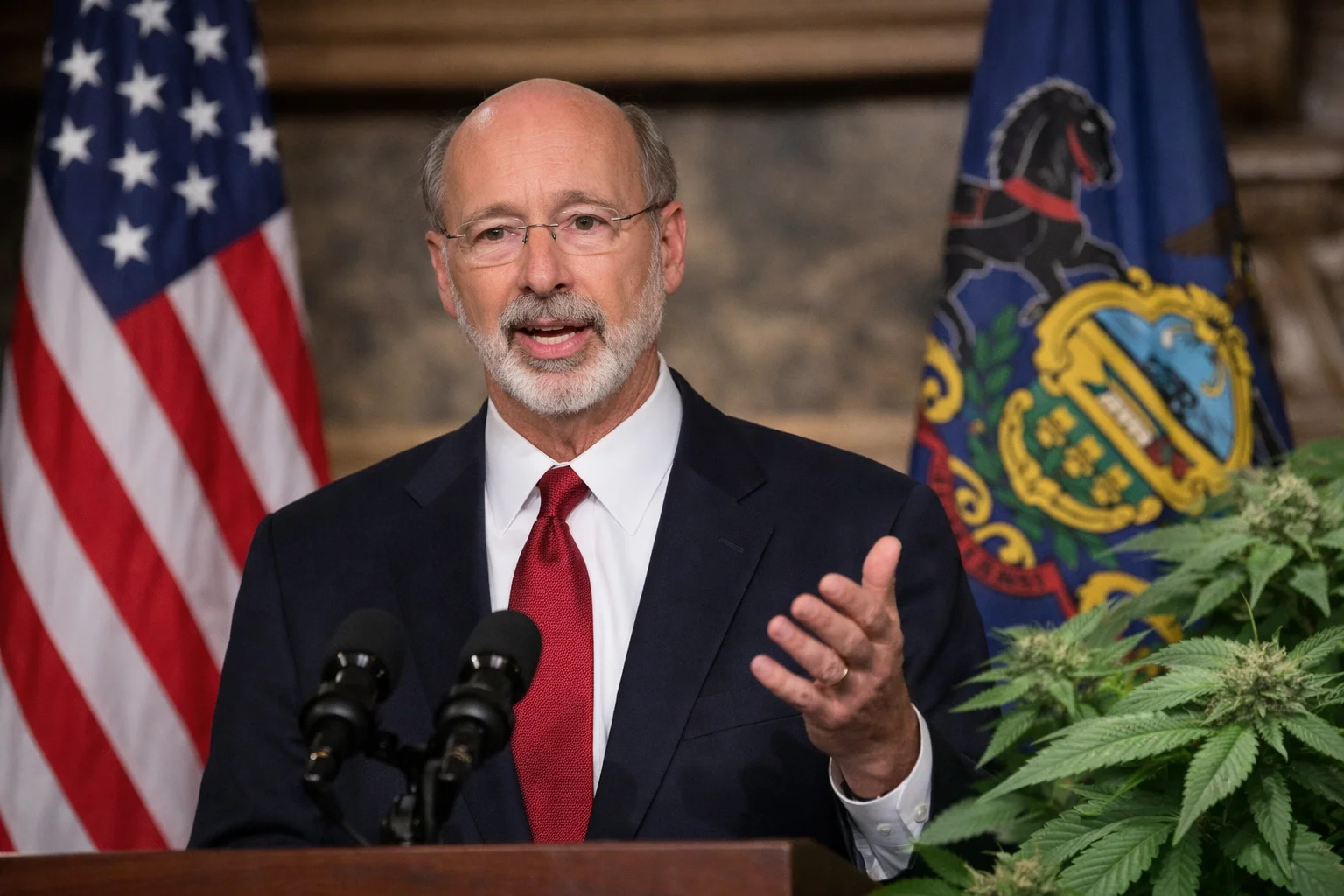
Pennsylvania Governor Josh Shapiro is once again pressing state lawmakers to legalize adult-use marijuana, arguing that evolving federal cannabis policy under President Donald Trump has cleared a major roadblock for reform. In his newly released 2026–2027 executive budget, Shapiro emphasized that continued inaction is costing the state revenue, public safety resources, and economic opportunity.
According to the governor, Pennsylvania is increasingly isolated as neighboring states move forward with regulated cannabis markets while federal authorities signal a shift away from strict prohibition.
Federal Cannabis Rescheduling Gives States New Momentum
The governor’s budget specifically references the federal government’s recent steps to reform cannabis policy, pointing to a proposal to reschedule marijuana from Schedule I to Schedule III under the Controlled Substances Act. President Trump has publicly called for this change, framing it as a “softening” of federal treatment toward cannabis.
Shapiro’s administration argues that this shift—combined with responsible regulatory models adopted by other states—creates a timely opportunity for Pennsylvania to act. While cannabis would remain federally illegal even under Schedule III, state leaders believe the reclassification reduces political and legal uncertainty surrounding legalization efforts.
For background on federal drug scheduling, readers can review guidance from the U.S. Controlled Substances Act, maintained by federal regulators .
Pennsylvania Falling Behind Neighboring States
The executive budget highlights that every neighboring state except West Virginia has legalized adult-use cannabis, leaving Pennsylvania at a competitive disadvantage. According to the administration, residents are crossing state lines to purchase legal marijuana, taking tax revenue and business growth with them.
The budget states that Pennsylvania lacks “commonsense protections” while continuing to lose economic activity to surrounding states with regulated markets.
Economic Impact and Revenue Projections
Shapiro wants lawmakers to pass a legalization bill quickly so implementation can begin July 1, with legal sales launching January 1, 2027.
Once fully implemented, the administration estimates:
-
$200 million annually in marijuana tax revenue
-
$36.9 million in the first year from a 20% wholesale tax
-
Revenue rising steadily to $223.8 million by 2030–2031
Unlike other fiscal proposals, the governor stressed that legalization would not require broad-based tax increases.
“This budget doesn’t require a broad-based tax increase today, tomorrow or at any point in the next five years,” Shapiro told lawmakers, dismissing claims to the contrary as political posturing.
Addressing Criminal Justice and Public Safety Concerns
The governor also framed legalization as a public safety issue. According to the budget, cannabis prohibition has burdened law enforcement and courts with low-level arrests while fueling illicit markets tied to violence and synthetic marijuana distribution.
Legalization, the administration argues, would allow police and courts to focus on serious crimes while replacing illegal markets with regulated systems.
Social Equity, Expungement, and Small Business Support
Shapiro’s proposal includes several equity-focused measures designed to address harms caused by past cannabis enforcement:
-
Immediate expungement of records for individuals incarcerated solely for cannabis possession
-
$10 million for restorative justice initiatives through the Pennsylvania Commission on Crime and Delinquency
-
$25 million to support small and diverse businesses entering the cannabis market, administered by the Department of Agriculture
The governor said these investments would help “right some of the wrongs done to individuals impacted by archaic laws.”
Licensing Fees and Market Structure
Under the proposed framework:
-
Adult-use dispensaries and new recreational retailers would pay a $25 million initial license fee
-
Annual renewal fees would total $500,000
-
Growers and farmers would pay $1,000 upfront and $1,000 annually
-
Processors and microbusinesses would face a $25,000 annual renewal fee
Medical marijuana dispensaries would be allowed to transition into the adult-use market under this structure.
Legislative History and Political Roadblocks
Despite repeated budget proposals from Shapiro, legalization has stalled. Last year, the Pennsylvania House passed a legalization bill proposing state-run cannabis stores, but the GOP-controlled Senate rejected it.
House Speaker Joanna McClinton recently acknowledged legalization as a “very important” revenue source, particularly for funding schools, transportation, and infrastructure. She noted that while the House has advanced bills on marijuana legalization, minimum wage increases, and skill game regulation, none have reached the governor’s desk.
Bipartisan Signals—but Persistent Skepticism
Several lawmakers believe federal rescheduling could help break the impasse in 2026.
-
Rep. Dan Frankel (D) said rescheduling would strengthen Pennsylvania’s existing medical marijuana system
-
Sen. Dan Laughlin (R) called Trump’s executive order a step toward “common-sense drug policy reform”
-
A Democratic senator said federal action could provide political cover for hesitant GOP lawmakers
However, Sen. Scott Martin (R) expressed skepticism, noting that marijuana would remain federally illegal even if rescheduled—raising doubts about whether the change would meaningfully alter legislative dynamics.
GOP Candidates and Revenue Disputes
Pennsylvania Treasurer Stacy Garrity (R), a leading Republican gubernatorial candidate, declined to take a clear position on legalization. She criticized the governor’s revenue projections as overstated, pointing to Ohio’s adult-use market, which generated about $115 million in revenue.
By contrast, Shapiro’s budget projects $536.5 million in the first fiscal year of implementation. Garrity said that if legalization proceeds, she would ensure revenues are “banked appropriately.”
Public Support and the Path Forward
Polls continue to show bipartisan voter support for marijuana legalization in Pennsylvania. Yet the issue remains stalled, largely due to Republican opposition—though not all GOP lawmakers are against reform. One Republican legislator recently suggested the party should seize the opportunity rather than allow Democrats to dominate the issue.
As the reform debate continues nationwide, platforms like Jolly Green Life continue tracking how shifting federal policy, state budgets, and public opinion are reshaping cannabis law across the U.S.
FAQs
Why is Pennsylvania’s governor pushing for marijuana legalization now?
Gov. Josh Shapiro says shifting federal cannabis policy, neighboring state legalization, and lost tax revenue make immediate action necessary.
How does federal cannabis rescheduling affect Pennsylvania legalization?
Proposed rescheduling to Schedule III signals a softer federal stance, reducing political and regulatory barriers for state-level reform.
When could legal marijuana sales begin in Pennsylvania?
If legislation passes quickly, implementation would start July 1, with adult-use cannabis sales beginning January 1, 2027.
How much revenue could legalization generate for Pennsylvania?
The state projects about $200 million annually once fully implemented, with revenue increasing to over $223 million by 2030–2031.
Will marijuana legalization increase taxes for residents?
No. The governor says the proposal regulates and taxes cannabis without raising broad-based taxes for Pennsylvanians.

James Carter has a background in science communication and a knack for breaking down complex topics into easy-to-understand stories. He loves diving deep into the facts behind CBD’s rise—from policy updates and market trends to new research. James is passionate about sharing the latest news and helping others understand what it all means. He writes clear and honest articles to keep readers updated on CBD laws, health benefits, and new products. When he’s not writing, he enjoys spending time outdoors and exploring natural ways to stay healthy.