
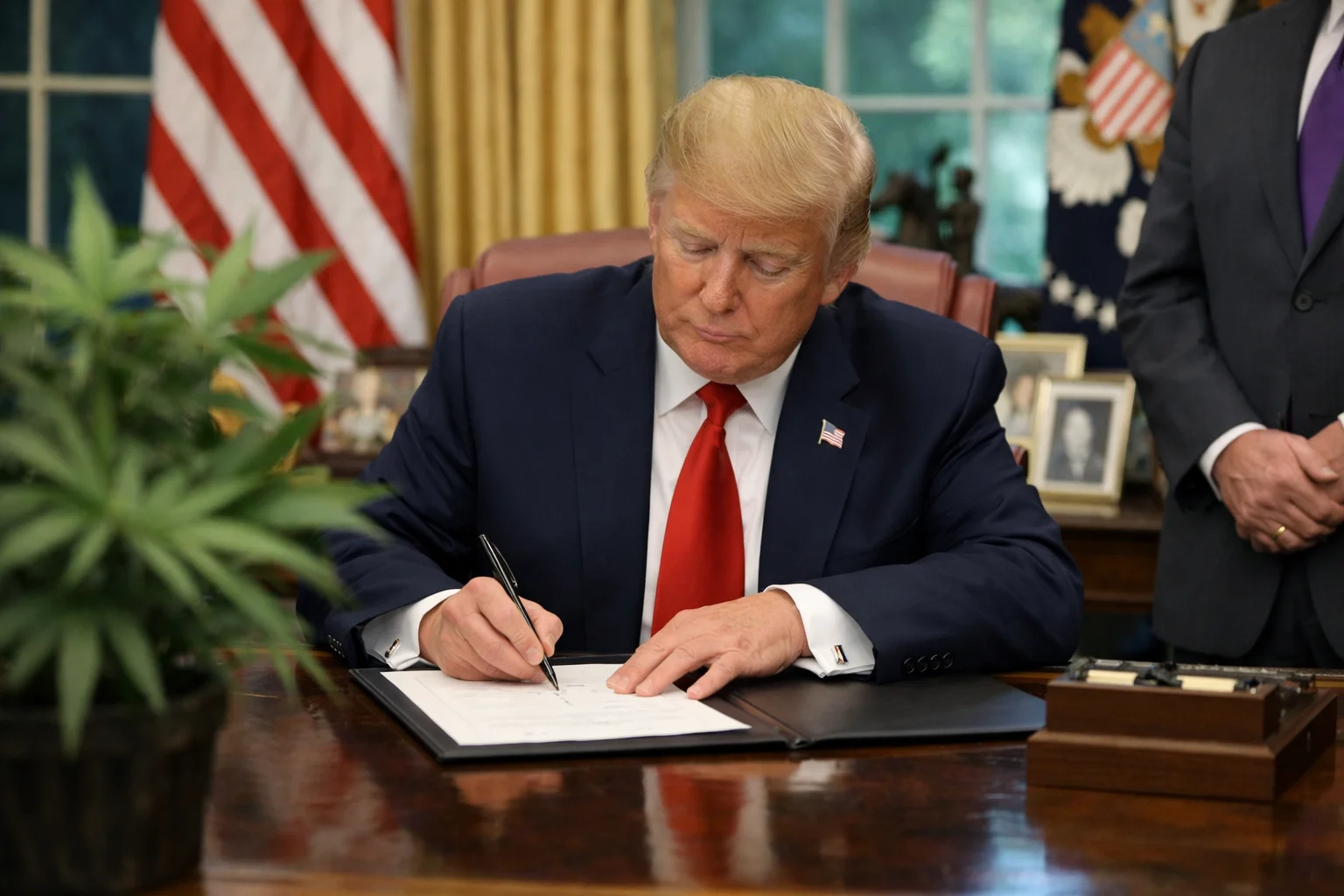
As cannabis advocates wait for federal action on marijuana rescheduling, President Donald Trump has signed a sweeping federal spending bill that once again prevents Washington, D.C. from launching legal recreational marijuana sales.
Although District voters approved adult-use marijuana legalization more than ten years ago, local leaders remain unable to authorize commercial cannabis sales due to a long-standing congressional restriction tied to federal funding.
Congressional Rider Keeps D.C. Sales Ban In Place
The restriction stems from an appropriations rider attached to the Financial Services and General Government (FSGG) funding bill. The provision bars the District of Columbia from using either federal or local funds to legalize or reduce penalties related to Schedule I substances, including marijuana and certain THC-related compounds.
This rider, originally championed by Rep. Andy Harris (R-MD), was retained in the most recent funding package approved by Congress and signed into law by President Trump on Wednesday.
Despite the continued push for cannabis reform nationwide, the language effectively keeps D.C. from establishing a regulated recreational marijuana market.
What The D.C. Marijuana Sales Rider Says
The rider explicitly states that no federal funds may be used to enact or enforce laws that legalize or reduce penalties for Schedule I substances under the Controlled Substances Act. It further extends that restriction to prevent the D.C. government itself from spending money to legalize recreational marijuana sales.
Notably, the provision also references “any tetrahydrocannabinols derivative,” a term that remains undefined in federal law, creating potential legal ambiguity.
Rep. Andy Harris Faces Political Uncertainty
While the rider survived this funding cycle, its primary sponsor could face political trouble ahead. Rep. Harris may be vulnerable in the upcoming election due to a redistricting plan recently approved by the Maryland House of Delegates.
Analysts suggest the new map would give Democrats an advantage in Maryland’s First Congressional District for the first time since 2011. However, the proposal must still clear the state Senate to take effect.
Could Federal Marijuana Rescheduling Change Everything?
Although the renewal of the rider represents another setback, policy analysts say a shift in federal marijuana scheduling could dramatically alter the situation.
If marijuana is moved from Schedule I to Schedule III under the Controlled Substances Act, it may allow D.C. to move forward with regulated adult-use sales despite the funding restriction.
According to a 2024 report from the Congressional Research Service, rescheduling would permit the District to authorize commercial marijuana sales, create regulatory frameworks, and levy cannabis taxes, even though marijuana would technically remain illegal at the federal level.
(Source: Congressional Research Service via Congress.gov)
The THC Derivative Loophole And Legal Uncertainty
Complications remain, however, due to the rider’s reference to “tetrahydrocannabinols derivatives.”
The CRS report warned that the lack of a clear definition could lead to interpretive challenges when determining whether a substance qualifies as marijuana, hemp, a THC derivative, or something else entirely.
Synthetic THC compounds remain illegal under D.C. law, but it is unclear whether courts would interpret these substances as falling under the rider’s restrictions. The overlap between marijuana, hemp, and THC derivatives adds another layer of legal uncertainty.
NORML Says Rescheduling Could Open The Door
Cannabis advocacy group NORML weighed in on the issue in 2024, arguing that federal rescheduling could finally allow D.C. to legalize adult-use marijuana sales.
The organization suggested that courts are unlikely to interpret the term “tetrahydrocannabinols derivative” as broadly covering marijuana itself, potentially weakening the rider’s impact if rescheduling occurs.
D.C. Can Still Prepare For Legal Sales
Even with the sales ban in place, federal oversight agencies have acknowledged that D.C. can take preparatory steps.
In 2021, the Government Accountability Office confirmed that District lawmakers are allowed to plan and prepare for a future recreational cannabis market, even if they cannot yet authorize sales.
It is also important to note that medical marijuana sales are already legal in Washington, D.C.
White House And Legal Challenges
Last year, the White House pointed to D.C.’s cannabis policy as an example of what it described as a “failed” approach that led to disorder.
Meanwhile, the Trump administration asked a federal court to dismiss a lawsuit filed by Capitol Hemp, a D.C.-based business challenging the sales ban. The Justice Department argued for dismissal on procedural grounds, and the court ultimately agreed, ending the case.
What This Means For Cannabis Reform
The continuation of the D.C. sales ban underscores the complex and often contradictory nature of U.S. cannabis policy. While voters, advocates, and local officials push for reform, congressional budget riders and federal classifications continue to shape what states and municipalities can actually do.
For ongoing coverage of cannabis policy shifts, legal analysis, and reform updates, visit Jolly Green Life
FAQs
Why does Congress keep blocking recreational marijuana sales in Washington, D.C.?
Congress includes a budget rider each year that prevents D.C. from using funds to legalize or regulate recreational cannabis sales, even though voters approved legalization.
Did President Trump personally create the D.C. marijuana sales ban?
No. The restriction has existed since 2014, but President Trump signed the latest federal spending bill that continues the policy.
Can D.C. sell marijuana if federal rescheduling happens?
Possibly. Legal analysts say moving marijuana from Schedule I to Schedule III could allow D.C. to regulate and tax recreational sales.
What is confusing about the term “tetrahydrocannabinols derivative”?
The term is not clearly defined in federal law, which creates uncertainty about whether it applies to marijuana, hemp, synthetic THC, or related products.
Are any cannabis products legally sold in Washington, D.C.?
Yes. Medical marijuana sales are legal and already operating within the District.

James Carter has a background in science communication and a knack for breaking down complex topics into easy-to-understand stories. He loves diving deep into the facts behind CBD’s rise—from policy updates and market trends to new research. James is passionate about sharing the latest news and helping others understand what it all means. He writes clear and honest articles to keep readers updated on CBD laws, health benefits, and new products. When he’s not writing, he enjoys spending time outdoors and exploring natural ways to stay healthy.